

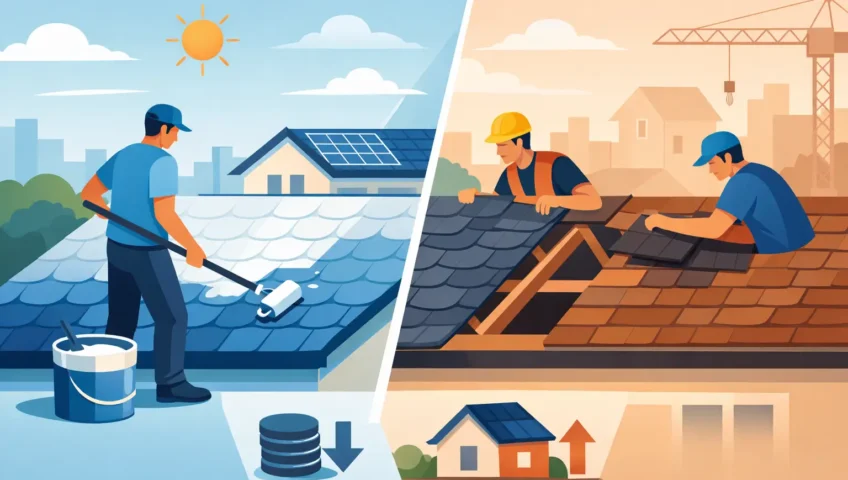
A roof rarely fails all at once. More often, it starts with damp patches in the loft, slipped tiles after a spell of bad weather, or a flat roof that has begun to hold water longer than it should. That is usually when the question comes up: roof coating vs replacement – which one actually makes sense for your property, your budget and the condition of the roof you already have?
The honest answer is that it depends on what is happening underneath the surface. A coating can be a very cost-effective way to extend the life of a roof that is basically sound. A replacement is the better investment when the structure is failing, the covering is too far gone, or repeated repairs are only delaying a larger problem. The right choice comes from a proper inspection, not guesswork.
Roof coating vs replacement: the real difference
Roof coating is a restoration treatment, not a rebuild. It is usually applied to an existing roof surface to improve waterproofing, protect against further weathering and refresh the appearance. In many cases, coatings are used alongside repairs, cleaning and preparation work. If the roof has minor defects, those need sorted before any coating goes on.
Roof replacement is exactly what it sounds like. The old roof covering is removed and a new system is installed. Depending on the roof type, that might mean new felt, membranes, tiles, slates, battens or other components. It is a bigger job, a bigger cost and a longer-term reset.
That difference matters because a coating can only work with what is already there. If the roof is still fundamentally doing its job, coating may add years of service and save a substantial amount compared with a full renewal. If the roof is deteriorating from the inside out, a coating will not fix that.
When roof coating is the sensible option
A roof coating tends to suit roofs that are ageing but still serviceable. That includes roofs with surface wear, faded finish, minor porosity, weather exposure and general signs of age that have not yet developed into serious structural problems.
On many domestic and commercial roofs, especially flat roofs and older tiled roofs, a coating can improve water resistance and reduce further deterioration. It can also help after roof cleaning and minor repairs, where the aim is to protect the roof and avoid a premature replacement bill.
This option is often attractive for homeowners and landlords who want to control costs without neglecting the property. If the underlying roof is stable and the defects are local rather than widespread, restoration can be a very practical middle ground.
Signs a coating may be enough
If the roof has isolated leaks rather than failures across large sections, coating may still be viable. The same applies if the tiles or roof surface remain largely intact, the timbers underneath are dry and sound, and there is no major sagging or movement.
Preparation is key here. A proper coating job is not a quick cover-up. The roof should be inspected, cleaned, repaired where needed and only then treated. If those steps are skipped, the result is unlikely to last.
When replacement is the better decision
There are times when spending less now simply leads to spending more later. If a roof is beyond economical repair, replacement is usually the smarter route.
That often applies where there are widespread leaks, severe wear, rotten timbers, recurring water ingress, major storm damage or an old roof that has reached the end of its service life. It also applies where multiple patch repairs have already been carried out and the same issues keep returning.
A new roof gives you a clean start. It deals with hidden defects, updates the full covering and reduces the likelihood of ongoing call-outs. For property owners planning to stay put for years, or landlords and commercial managers who need a dependable long-term solution, that matters.
Signs replacement is hard to avoid
If the roof deck is failing, if slates or tiles are breaking down across large areas, or if previous repairs are no longer holding, a coating is unlikely to be enough. The same is true when moisture has been getting in for some time and affected the roof structure.
At that stage, adding a coating may improve appearance temporarily, but it will not solve the real issue. A proper replacement protects the building properly and gives clearer value over time.
Cost matters, but so does value
For many customers, the first question is price. That is understandable. In straightforward terms, coating is usually cheaper than full replacement. There is less labour, less material and less disruption.
But cheaper is not always better value. If a coating gives you several more years from a sound roof, it can be money well spent. If it is applied to a roof that should really be replaced, it becomes an avoidable extra cost before the main job still has to be done.
The better question is not just, “What costs less today?” It is, “What solves the problem properly for the next few years?” A sound recommendation should take both into account.
Lifespan and performance
A replacement should last significantly longer than a coating, assuming the materials are suitable and the work is completed correctly. That makes it the stronger long-term option when a roof is in poor condition.
A coating, on the other hand, is about extending service life rather than starting over. Its performance depends on the roof type, the product used, the weather exposure and, most importantly, the condition of the roof before application. A well-prepared roof can benefit greatly. A neglected one will not.
This is why no reputable roofer should promise that coating is right for every roof. It is a useful service, but not a miracle cure.
Roof coating vs replacement for different property types
The decision can vary by building. On a family home, appearance and cost may both be major factors. On a rental property, landlords often want the most practical option with the least disruption. On commercial and agricultural buildings, keeping the property weather-tight with minimal downtime is often the priority.
Flat roofs are a good example. In some cases, a flat roof coating can restore performance and delay replacement at a much lower cost. In others, if the membrane has failed or water has been getting below the surface, a full renewal is the only dependable answer.
Older pitched roofs also vary. Some simply need repairs and protection. Others have reached the stage where replacing the covering is the only realistic way to stop ongoing problems.
The risk of choosing too quickly
One of the biggest mistakes property owners make is deciding before the roof has been properly assessed. A leak does not always mean the whole roof is finished. Equally, a roof that still looks acceptable from the ground can have serious defects up close.
That is why an inspection matters. It should look at the visible covering, the weak points around ridges, flashings and valleys, and any signs of moisture or decay underneath. Once that is clear, the decision between coating and replacement becomes much more straightforward.
A trustworthy contractor should explain what is repairable, what is not, and whether restoration would genuinely give worthwhile extra life. If replacement is needed, that should be said plainly.
What property owners in Scotland should keep in mind
Scottish weather is hard on roofs. Driving rain, wind exposure, moss growth and repeated freeze-thaw cycles all take their toll. That is one reason roofs in areas such as Glasgow, Hamilton and across Lanarkshire often need attention before owners expected.
In this climate, early action usually saves money. Small defects can often be repaired and protected before they turn into widespread damage. Leave them too long, and the balance shifts from restoration to replacement.
For that reason, the best time to ask about coating or replacement is not when the damage has become severe. It is when the first warning signs appear.
Making the right call
There is no one-size-fits-all answer to roof coating vs replacement. Coating is a strong option when the roof is still structurally sound and you want to extend its life at a lower cost. Replacement is the better route when the roof is failing, repairs are stacking up or hidden damage has already gone too far.
At Varey Contracts Ltd, that decision starts with a proper look at the roof and honest advice on what gives you the best value. If your roof can be repaired and coated, that should save you money. If it needs replaced, you are better knowing now than paying twice later.
A roof does not need to be perfect to be worth saving, but it does need to be sound. That is the line that matters most when choosing the next step.


