

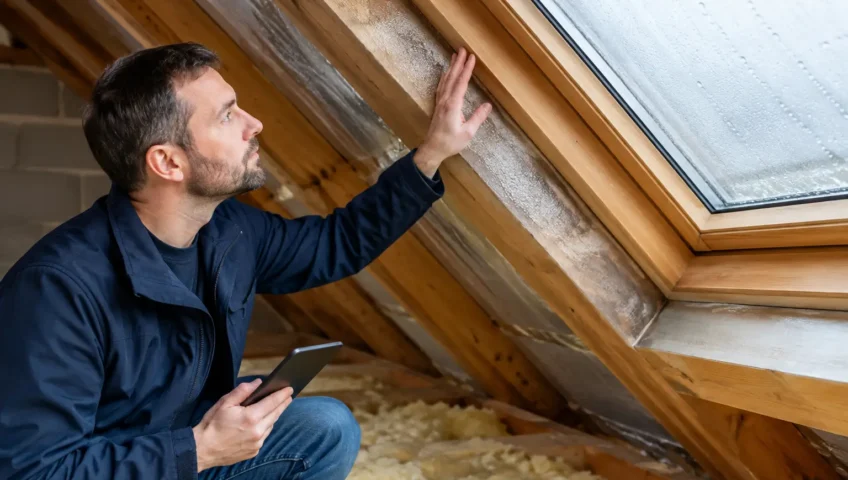
Water droplets on roofing felt, damp loft timbers and a musty smell after a cold spell are all signs that moisture is building up where it should not be. Knowing how to stop roof condensation early can protect insulation, prevent timber decay and help you avoid a much more expensive roof repair later on.
Roof condensation is especially common in Scottish homes during autumn and winter. Warm, moisture-laden air from bathrooms, kitchens and everyday living rises into a cold loft. When that air meets the cold underside of the roof covering or felt, it turns back into water. The solution is not simply to make the loft warmer. It is to control moisture, maintain the right ventilation and make sure insulation has been fitted correctly.
First, make sure it is condensation rather than a roof leak
Condensation can look very similar to a leaking roof, particularly when water is dripping from felt or running down rafters. The difference is often in the pattern. Condensation tends to be worse after cold nights, during wet weather with no obvious roof damage, or when the home has been closed up with little ventilation. It may appear across a wide area of the loft rather than beneath one specific point.
A leak is more likely if there is a clear wet patch under broken or slipped slates, damaged flashing, a roof valley, chimney, skylight or pipe penetration. Staining that becomes worse after heavy rain is another warning sign. Blocked gutters and defective roofline components can also allow water into areas where it can be mistaken for condensation.
Do not assume the cause based on appearance alone. A proper roof inspection can identify whether you have a ventilation issue, a roof defect, or both. This matters because improving ventilation will not repair cracked flashing, and replacing a few tiles will not solve warm household air escaping into the loft.
How to stop roof condensation at the source
The most effective approach is to reduce the amount of moist air reaching the loft, then provide a clear route for any remaining moisture to escape. Every property is different, but these are the areas that usually need attention.
Keep loft ventilation clear and continuous
A loft needs ventilation at eaves level, and sometimes at the ridge or high level too, depending on the roof design. This allows air to move through the roof space rather than sitting against cold timbers and felt.
Look outside for soffit vents or discreet ventilation openings along the eaves. Inside the loft, check that insulation has not been pushed tightly into the eaves and blocked the airflow. This is a common problem after extra insulation has been laid, often with the best intentions. The insulation improves heat retention but accidentally seals off the ventilation gap.
Ventilation trays or baffles can keep insulation back from the eaves while maintaining a clear path for air. Where an older roof has limited ventilation, a roofer may recommend additional eaves vents, tile vents or ridge ventilation. The right choice depends on the roof construction. Adding vents at random can be ineffective, and poorly fitted vents can create new weatherproofing problems.
Check that bathroom and kitchen extractors vent outside
Steam from showers, baths, cooking and drying clothes is a major source of roof condensation. Extractor fans should discharge directly outside through a suitable external vent. They should never release moist air into the loft.
Check for flexible ducting that has come loose, been crushed, or ends inside the roof space. Also look for uninsulated ducting. Warm air travelling through a cold loft can condense inside the duct, then run back towards the fan or drip onto insulation. Insulated ducting, short runs and properly sealed connections make a real difference.
A fan is only useful if it is working well enough to remove moisture. If the bathroom mirror remains steamed up long after a shower, the fan may be underpowered, dirty, poorly ducted or not running for long enough. Humidistat fans and timer-controlled extractors can be worthwhile in busy households.
Improve insulation without blocking the roof space
Loft insulation should sit evenly across the ceiling joists, keeping warmth in the rooms below. It should not be piled against the underside of the roof unless the roof has been designed and insulated as a warm-roof construction.
For a traditional cold loft, the roof space above the insulation is meant to remain cold and ventilated. If insulation is stuffed around the eaves, packed tightly under the felt or placed over ventilation openings, condensation can become worse rather than better.
Pay attention to gaps in the ceiling below the loft as well. Unsealed openings around pipes, cables, loft hatches, recessed lights and soil stacks allow warm air to rise straight into the roof space. A draught-proofed, insulated loft hatch and careful sealing around service penetrations can reduce this air leakage significantly.
Reduce excess moisture inside the property
No roof ventilation system can fully compensate for very high humidity indoors. Small changes in daily routines are often part of the answer, especially in older homes with limited mechanical extraction.
Dry clothes outdoors where possible, or use a vented tumble dryer correctly. Keep lids on pans when cooking, use kitchen extraction and close bathroom doors during and after showers. Open trickle vents if your windows have them, and avoid turning the home into an airtight box for long periods.
A dehumidifier can help manage humidity, particularly while you are investigating the underlying cause. However, it should support proper ventilation and repairs, not replace them. If it is constantly collecting large amounts of water, the property may have a bigger moisture issue that needs attention.
Roof construction can change the solution
Not every roof should be treated in the same way. A pitched slate or tiled roof with a cold loft has different ventilation needs from a modern insulated warm roof. Flat roofs, converted lofts and agricultural buildings can be more complex again.
Older roofs may have traditional sarking boards beneath the slates, while others have breathable membrane or older non-breathable felt. A breathable membrane can help manage water vapour, but it is not a substitute for adequate airflow. Likewise, installing extra roof vents may not resolve condensation if warm air is entering through gaps in the ceiling or a bathroom fan is exhausting into the loft.
Loft conversions need particular care. The insulation, vapour control layer, ventilation gap and roof covering must work together. If one layer is missing or damaged, moisture can be trapped within the structure where it is harder to see. In this situation, a professional assessment is far safer than a quick fix.
Signs that condensation is already causing damage
A small amount of seasonal moisture does not always mean the roof is failing, but persistent condensation should not be ignored. Look for black mould on timbers or felt, rusty nail heads, damp or flattened insulation, peeling paint around ceiling edges, and a lingering stale smell in the loft.
Timbers that remain wet can eventually suffer decay. Wet insulation loses performance, allowing more heat to escape and increasing heating costs. In severe cases, condensation can lead to staining and damp patches on ceilings below, even though the roof covering itself is intact.
It is worth checking the loft on a cold morning, particularly after showers, cooking or clothes drying the evening before. Take photographs of any droplets, mould, staining or damaged felt. This gives a roofing specialist a clearer picture of what is happening and whether the issue is widespread or localised.
When to call a roofing professional
Call for advice if water is dripping in the loft, timbers feel damp, mould is spreading, insulation is wet, or you cannot tell whether the issue is condensation or a leak. It is also sensible to arrange an inspection before spending money on new insulation, vents or coatings. The wrong work can leave the underlying cause untouched.
A thorough inspection should consider the roof covering, ridge and eaves, flashing, gutters, soffits, ventilation routes, insulation layout and any extractor ducting in the loft. For homeowners and property managers across Glasgow and Lanarkshire, Varey Contracts Ltd can assess the condition of the roof and provide a free written quote for any repair or ventilation work required.
Roof condensation is usually fixable, but it responds best to a joined-up solution rather than a single quick patch. Deal with the moisture source, protect the ventilation paths and get any genuine roof defects repaired before a damp loft turns into damaged timber and costly internal repairs.


