

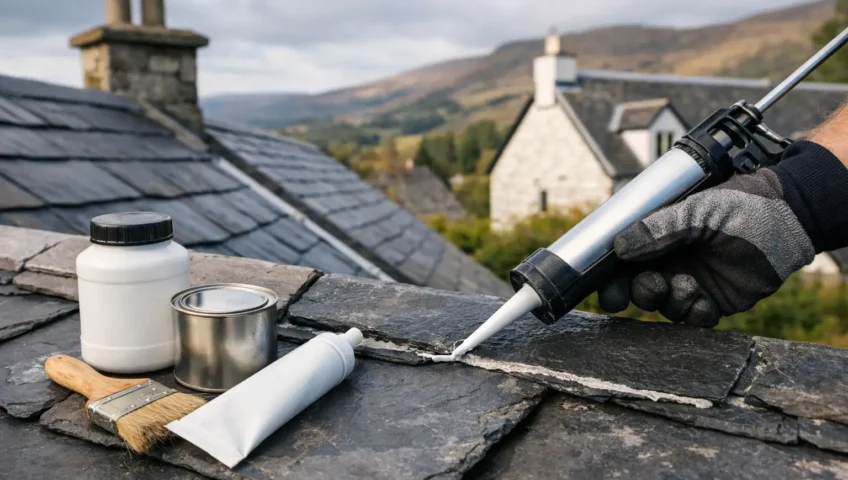
A leaking roof does not always mean a new roof is required. In many cases, the right repair work followed by a suitable coating can extend the working life of a sound roof and protect the property for years to come. This roof sealant products review looks at the main options, where they work well and, just as importantly, when sealant is not the answer.
For homes and commercial properties across Glasgow and Lanarkshire, the weather is a major factor. Persistent rain, frost, wind-driven water, moss growth and repeated temperature changes all put roof coverings under pressure. A quality product matters, but careful preparation and correct application matter just as much.
What a Roof Sealant Can and Cannot Do
Roof sealants and coatings are designed to form a protective barrier over an existing surface. Depending on the product and roof type, they can improve water resistance, cover minor surface porosity, reduce further weathering and refresh the appearance of tired tiles or flat roofing.
They are not a shortcut around serious defects. A coating will not correct rotten timbers, failed roof structure, widespread cracked tiles, loose slates, damaged flashing or a flat roof membrane that has reached the end of its life. Applying sealant over an active fault may hide the problem briefly while water continues to find its way underneath.
That is why a proper inspection comes first. The best-value solution may be a targeted repair and sealant application, but it could also be replacing a small section, renewing flashings or fitting a new roof covering where repairs would only delay a bigger issue.
Roof Sealant Products Review: The Main Types
Different roof materials need different products. Choosing by price alone is usually where problems begin, particularly on older Scottish properties with mixed repairs or weathered surfaces.
Acrylic roof coatings
Acrylic coatings are commonly used on suitable flat roofs and on some tile surfaces. They are water-based, relatively straightforward to apply in the right conditions and available in a range of colours. Once cured, a good acrylic system creates a flexible protective finish that can help resist rain and ultraviolet exposure.
Their main advantage is value. For a flat roof that remains structurally sound but is starting to show surface wear, an acrylic coating system can be a cost-effective restoration option. It is not ideal for every roof, however. The surface needs to be clean, dry and stable, and areas of standing water must be addressed first. Constant ponding can shorten the life of any coating.
Bitumen-based sealants and coatings
Bitumen products have long been used for flat roof repairs, felt roofs and small localised patching work. They are familiar, practical and can offer good water resistance when matched to the right substrate. Fibre-reinforced versions can provide useful strength around minor splits, laps and repaired areas.
The trade-off is appearance and flexibility over time. Bitumen can become brittle as it ages, especially after repeated cold weather, and it is not a cure for widespread membrane failure. It is often best used as part of a specific repair rather than as a blanket answer to every flat roof problem.
Liquid rubber and liquid-applied systems
Liquid-applied rubber coatings are a strong option for many flat roof restoration projects. Applied correctly, they form a continuous waterproof layer without the vulnerable joints found in some traditional systems. Their flexibility is particularly useful where a roof expands and contracts through changing temperatures.
These systems can be excellent around awkward roof details, penetrations, upstands and complicated shapes. They need professional surface preparation and the correct primer where required. A badly cleaned roof, trapped moisture or an unsuitable base can undermine an otherwise high-quality product.
Tile roof sealants and protective coatings
Roof tile coatings are often chosen to revive faded concrete tiles after cleaning and repairs. They can improve the appearance of the roof while adding a water-repellent protective finish. Some systems are also formulated to discourage rapid dirt and moss build-up, although no coating will stop organic growth forever in damp, shaded areas.
This is where honest advice is essential. A tile coating is worth considering when tiles are fundamentally sound, securely fixed and simply weathered or porous. If the roof has extensive cracking, frost damage, failing underfelt or frequent slipped tiles, money is usually better spent on repairs or renewal work first.
Sealants for flashing, joints and small defects
Polyurethane, silicone and hybrid sealants are useful for specific details such as flashings, joints, rooflight edges, pipe penetrations and minor gaps. They are repair products rather than whole-roof coatings. A flexible, compatible sealant can stop a small issue becoming a larger leak, but it must be applied to a sound, clean surface.
Silicone is not automatically the best choice simply because it is waterproof. Some products do not adhere well to certain surfaces, and others can make future repairs or coatings more difficult. The right sealant depends on the materials involved and whether the area moves, holds water or receives direct sunlight.
The Product Is Only Half the Job
The difference between a coating that lasts and one that peels within a season is usually preparation. Before any roof sealant product is applied, the roof should be inspected, cleaned and repaired properly. Moss, algae, loose material, dust and old failing coatings all interfere with adhesion.
On tiled roofs, this may include careful cleaning, replacing broken tiles, securing ridge components and checking valleys, flashing and gutters. On flat roofs, attention should be given to splits, blisters, open laps, drainage outlets and low spots where water sits after rainfall.
Weather conditions also matter. Most products have clear requirements for surface temperature, air temperature and drying time. Applying a coating just before rain, onto a damp roof or during unsuitable cold conditions is a false economy. A professional team plans the work around the forecast and uses compatible primers, reinforcing materials and top coats where the system requires them.
When Is Roof Sealing Good Value?
Roof sealing can offer real savings where the roof is serviceable but beginning to show its age. It is particularly worthwhile for owners who want to improve protection and appearance without moving straight to a full replacement. Landlords and commercial property managers can also benefit where preventative maintenance helps avoid disruption from leaks.
It is less suitable where the roof is already failing across multiple areas. If water has entered the roof structure, insulation is saturated, decking is soft or tiles are badly deteriorated, coating over the surface can create a neat-looking roof without solving the underlying risk.
A good contractor should be prepared to say when a sealant system is not the right investment. That advice may not be what a property owner wants to hear, but it prevents money being spent twice.
Questions to Ask Before Approving a Coating
Before choosing a product or accepting a quote, ask what repairs are included before coating begins, how the roof will be cleaned and dried, and whether a primer or reinforcement layer is needed. You should also ask how drainage issues will be dealt with, what guarantee is provided for the workmanship and whether the coating is suitable for your specific roof material.
It is sensible to ask for the condition of the roof to be explained in plain terms. You do not need a technical lecture, but you should know whether the work is a repair, a restoration system or a temporary measure intended to buy time before renewal.
A Practical Choice for the Right Roof
The strongest result does not come from choosing the thickest or cheapest tin of sealant. It comes from matching the product to the roof, dealing with defects first and applying the system properly. For a sound flat roof or weathered tile roof, that can mean valuable extra years of protection at a fraction of replacement cost.
If you are seeing staining on ceilings, loose tiles, recurring moss, worn flat roofing or water around flashings, arrange a professional inspection before the next spell of heavy rain. Varey Contracts Ltd can assess the condition of your roof, explain the practical options and provide a free written quote for repair, coating or replacement work.


